June, 2026
Home › Banking Systems › Online Banks vs Traditional Banks › Can Online Banks Replace Traditional Banks Completely?
What You Need to Know
— For most people in most financial situations, online banks can handle 90–95% of daily banking needs. The question is whether your specific situation falls in the remaining 5–10% where a traditional bank relationship is still required.
— The honest answer for most Millennials and Gen Z with W-2 income, digital payment habits, and no regular cash handling: yes, an online-only setup works. The answer changes when cash deposits, complex lending, or high-stakes problem resolution become part of the picture.
— The four situations where online banks cannot fully replace traditional banks: regular cash deposits, complex mortgage or business lending, international wire transfers with complications, and high-stakes account disputes requiring in-person resolution.
— The answer is not permanent. A 24-year-old with a digital paycheck and no cash business can go fully online. The same person at 34 with a mortgage application, a side business, and irregular cash income probably cannot.
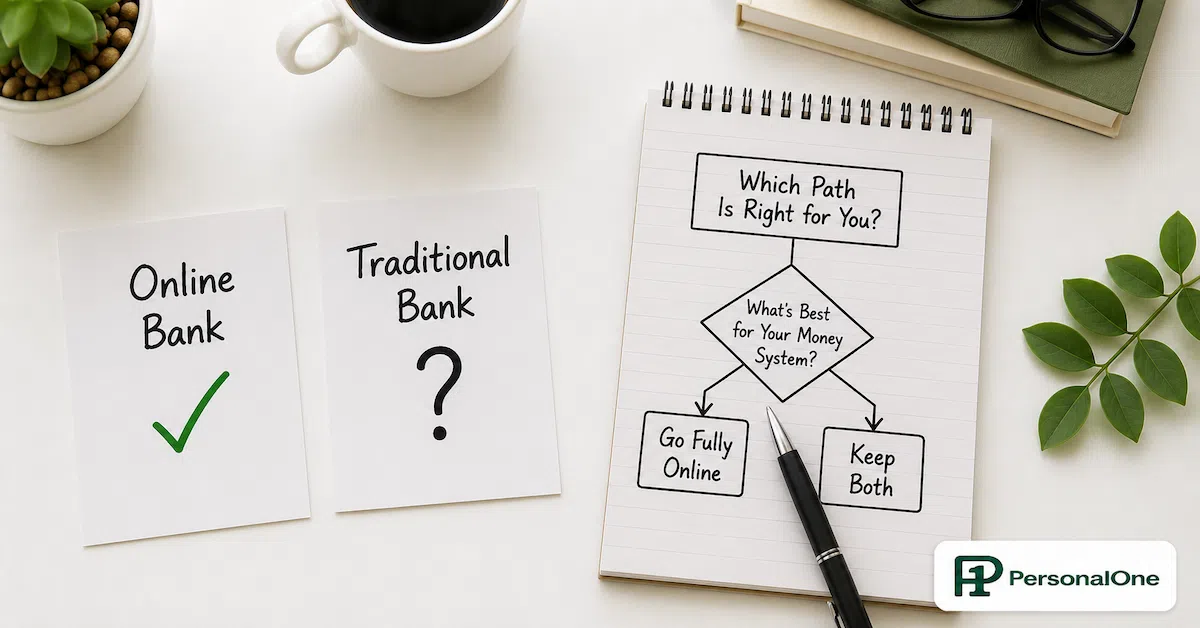
— The better question is not "can I replace my traditional bank?" but "which specific jobs does my traditional bank do that an online bank cannot do for my situation right now?" That question has a clear, answerable answer.
Can online banks replace traditional banks completely? The answer most financial sites give is "it depends" — which is technically accurate and practically useless. It depends on what, exactly? What are the specific conditions under which an online-only banking setup works, and what are the specific conditions under which it breaks down? That is the question worth answering, and it has a clearer answer than most financial advice suggests.
For a significant portion of the Millennial and Gen Z population — those with direct deposit income, digital payment habits, no regular cash business, and banking needs that fit entirely within what an app and a browser can handle — an online-only setup works completely. Not theoretically. Actually. The features that traditional banks offer but those readers rarely use (branch tellers, in-person loan officers, safe deposit boxes) are real features that simply do not apply to their current financial life.
For others — those who deposit cash regularly, need a mortgage from an institution that values the relationship, run a business with physical cash flow, or deal with complex financial situations that benefit from in-person resolution — the traditional bank relationship is not legacy inertia. It is functional infrastructure that online banks genuinely cannot replicate today. This article identifies exactly where the line is and which side of it you are on.
What Online Banks Can Already Do Completely
The capability gap between online and traditional banks has closed significantly over the past five years. The list of things online banks genuinely cannot do is shorter than most people assume. Before identifying where the gap remains, it is worth being precise about where it does not.
Checking and savings accounts: Functionally identical to traditional bank accounts. FDIC-insured, same deposit protections, same ACH transfer network. The only difference is the interface — app and browser instead of teller window.
Direct deposit: Every major employer's payroll system can route to any FDIC-insured account regardless of whether it is at an online or traditional bank. Direct deposit to an online bank is identical to direct deposit anywhere else.
Bill payment and autopay: All online banks support ACH bill payment. Every biller that accepts bank transfer — utilities, insurance, rent, loan servicers — works with online bank accounts identically to traditional bank accounts.
ATM access: The major online banks (Ally, Marcus, American Express, Discover, Capital One 360) partner with Allpoint and MoneyPass networks providing fee-free access to 55,000+ ATMs nationwide. This exceeds the proprietary ATM network of most regional traditional banks.
Mobile check deposit: Every major online bank accepts mobile check deposits via app. Processing times are typically one to two business days — identical to traditional bank mobile deposit.
Peer-to-peer transfers: Zelle, Venmo, PayPal, and Cash App all link to online bank accounts identically to traditional bank accounts.
High-yield savings: Online banks consistently offer 4–5% APY versus 0.42% national average at traditional banks. On a $15,000 emergency fund, that differential produces $612 more per year in earnings. The structural reason online banks pay higher rates is permanent — not promotional.
The Four Situations Where Online Banks Cannot Fully Replace Traditional Banks
This is the precise list. Not a general "traditional banks have branches" observation — the specific situations where the absence of a traditional bank creates a functional gap that online banks cannot bridge in 2026.
Situation 1 — Regular Cash Deposits
This is the most common and most concrete limitation. Online banks do not accept cash deposits at branches because they have no branches. Some partner with Green Dot at retail locations (Walgreens, CVS, Dollar General) for cash deposits, but the process adds fees, has per-transaction and monthly limits, and is genuinely inconvenient for regular use.
Who this affects: people who receive tips, in-person service income, cash from sales, rental cash payments, or any other regular cash income stream. Small business owners with cash registers. Anyone who routinely handles physical currency that needs to enter the banking system.
Who this does not affect: the majority of salaried employees, most remote workers, most freelancers paid by invoice, and anyone whose income arrives entirely digitally. If you cannot remember the last time you needed to deposit physical cash, this limitation is not relevant to your situation.
Situation 2 — Complex Mortgage or Business Lending
Some online banks offer mortgages and personal loans, but the landscape is uneven. More importantly, the lending relationship with a traditional bank — particularly for complex situations like self-employed mortgage applications, business lines of credit, commercial real estate, or SBA loans — benefits significantly from the in-person relationship and the institutional knowledge a local bank officer develops over time.
A self-employed borrower with two years of freelance income applying for a mortgage faces underwriting scrutiny that benefits from a loan officer who understands the business model and can advocate for the application. That relationship does not exist with an online bank's automated loan processing.
Who this affects: self-employed borrowers, small business owners seeking credit, anyone with a non-standard income profile applying for a mortgage, and anyone seeking business banking products beyond basic checking. Who this does not affect: W-2 borrowers with straightforward income documentation applying through standard mortgage channels, where online lenders are often competitive.
Situation 3 — International Wire Transfers With Complications
Routine international transfers work fine through online banks and services like Wise or Remitly. The gap appears when an international wire is flagged, delayed, or disputed — when something goes wrong and resolution requires direct communication with a compliance officer or correspondent banking relationship.
Online banks handle flagged international transfers through support tickets and escalation queues. Traditional banks handle them with a wire transfer specialist who can call the correspondent bank directly. For time-sensitive or high-value international transactions where complications arise, the traditional bank relationship reduces resolution time from days to hours.
Who this affects: people who send regular international wire transfers, expats with accounts in multiple countries, people supporting family abroad with regular transfers, and anyone who has experienced a flagged or delayed international wire. Who this does not affect: anyone who does not send international wire transfers.
Situation 4 — High-Stakes Account Disputes and In-Person Resolution
Fraud disputes, large unauthorized transactions, account freezes, and identity theft resolutions are handled by online banks through remote support channels. For most routine disputes, this is entirely adequate. For large-dollar situations — a $15,000 fraud claim, a disputed wire, a frozen account during a financial emergency — the ability to walk into a branch and speak with a manager who can escalate immediately has meaningful value.
Online bank support, even when excellent, operates on queue timelines. A branch manager can call the fraud department directly from a desk while you sit across from them. That difference matters most at the highest-stress, highest-stakes moments in banking — which are precisely when the in-person relationship earns its keep.
Who this affects: anyone who has experienced significant banking fraud, account freezes, or complex disputes. Who this does not affect: most people most of the time. This is a tail-risk consideration, not a daily banking function.
What I've Seen
The clients who successfully go fully online share three characteristics: their income arrives digitally, they do not handle physical cash regularly, and they are at least two years away from a mortgage application. The clients who try to go fully online and run into problems almost always hit one of two walls — a cash deposit situation they did not anticipate, or a mortgage pre-approval process where the absence of a traditional banking relationship created underwriting friction that cost them time and negotiating position. The solution in every case was not to abandon the online bank. It was to keep a minimal traditional bank account alongside it for the specific functions it handles better.
The Test: Can You Go Fully Online Right Now?
Work through these five questions. If you answer no to all five, an online-only banking setup works for your current situation. If you answer yes to any of them, keep reading the next section.
The Five-Question Fully-Online Test
1. Do you regularly deposit physical cash? Tips, in-person service income, cash from sales, rental payments. If yes — online-only does not fully work for your situation.
2. Are you self-employed or applying for a complex mortgage within the next 18 months? Freelance, contract, small business ownership, or any non-standard income profile. If yes — a traditional bank relationship for lending purposes has concrete value.
3. Do you send regular international wire transfers? Supporting family abroad, international business payments, expat accounts. If yes — a traditional bank relationship for wire resolution is worth maintaining.
4. Have you experienced significant banking fraud or account disputes in the past? If yes — the in-person dispute resolution capability is not theoretical for you. It has already been relevant once.
5. Do you use any services only available at physical branches? Safe deposit box, notary, cashier's checks, in-person loan origination. If yes — those specific services require a traditional bank account.
If You Cannot Go Fully Online: The Minimum Traditional Bank Footprint
The answer to "can I go fully online?" being "not yet" does not mean staying at a traditional bank for everything. It means maintaining the minimum traditional bank relationship that covers the specific functions online banks cannot perform, while moving everything else to online institutions where the rates, fees, and tools are better.
The minimum traditional bank footprint for most people who need one is simple: a free checking account at a local bank or credit union, used specifically for cash deposits, ATM access in the local network, and the institutional relationship that supports lending. No savings products at the traditional bank — those move to the online high-yield savings account. No excess funds parked there earning near-zero interest. Just the account that does the jobs online banks cannot.
This is the hybrid banking setup in practice. Two institutions, each assigned the role it does best. The traditional bank handles cash, ATM, and lending relationship. The online bank handles savings at competitive rates, fee-free daily banking, and automation tools. The management overhead is one additional app. The financial benefit — higher savings rates, lower fees, better tools — is immediate and permanent. For the full transition process when making this switch, how to switch from a traditional bank to an online bank covers the step-by-step process.
How This Changes Over Time
The answer to whether online banks can replace traditional banks is not static. It changes as financial life evolves. The same person gives different answers at different life stages — and the banking structure should evolve to match.
Early career, W-2 income, no cash business, renting: Online-only setup works completely. No cash deposits, no mortgage, no complex lending needs. Every banking function fits within what an app can handle. The account structure upgrade path shows how to build the right setup at this stage.
Mid-career, mortgage approaching, possibly self-employed: Traditional bank relationship becomes relevant again — specifically for the lending relationship and the underwriting process. A minimal traditional bank account maintained alongside the online banking setup covers this without abandoning the rate and fee advantages of online banking.
Business ownership, cash handling, international transfers: Traditional bank relationship is functional infrastructure, not preference. The specific services required are not available online. The hybrid setup keeps online banks in the roles they dominate while traditional banking handles the functions it cannot.
Post-mortgage, established career, no cash business: The pendulum can swing back toward online-only for daily operations, with the traditional bank relationship maintained minimally for its remaining functional value — or discontinued if that value no longer applies.
The Right Answer Is Specific to Your Situation. The Framework Makes It Clear.
Whether you go fully online, run a hybrid setup, or keep both institutions for specific roles, the decision starts with understanding which jobs each institution actually does for your specific financial life. The complete framework is in Online Banks vs Traditional Banks and the Banking Systems hub.
Frequently Asked Questions
Is it safe to go fully online with your banking?
Yes, provided the online bank is FDIC-insured. FDIC insurance covers up to $250,000 per depositor per institution regardless of whether the bank has physical branches. The safety of deposits at an FDIC-insured online bank is identical to the safety of deposits at an FDIC-insured traditional bank. The risk profile of going fully online is not about deposit safety — it is about the functional gaps covered in this article. Verify any institution's FDIC status at fdic.gov before opening an account.
What about credit unions — are they a better alternative to traditional banks?
Credit unions occupy a middle position that works particularly well as the traditional bank component in a hybrid setup. They are member-owned nonprofits, which typically means lower fees, better overdraft policies, and strong ATM access through shared networks. For the operational layer of a hybrid setup — the institution handling cash deposits, local ATM access, and lending relationships — credit unions often outperform both traditional banks and online banks on fee structure. The full comparison is in online banks vs credit unions.
Can I get a mortgage if all my accounts are at online banks?
Yes — online bank statements are fully acceptable documentation for mortgage applications. The issue is not where your accounts are held. The issue is whether having a pre-existing lending relationship with a traditional bank gives you any underwriting advantage. For W-2 borrowers with straightforward income, this advantage is minimal and online lenders like Rocket Mortgage and Better are fully competitive. For self-employed borrowers or anyone with a non-standard income profile, the in-person loan officer relationship at a traditional bank or credit union has more concrete value during underwriting.
What is the minimum I need at a traditional bank if I want to primarily use online banking?
A free checking account — no monthly fee, no minimum balance requirement, ideally with local ATM access or ATM fee reimbursement. Most credit unions and some traditional banks offer this. Use it for cash deposits, the local ATM network, and maintaining the institutional relationship for eventual lending needs. Keep zero savings at the traditional bank — those belong in the online high-yield savings account. The traditional bank account should cost nothing and require minimal interaction. Its value is the specific functions it provides that online banks cannot.
Will online banks eventually replace traditional banks entirely?
The trajectory points toward online banks handling an increasing share of daily banking. McKinsey's 2026 Global Banking Annual Review notes that neobanks are showing strong growth and superior returns, and that Gen Z is significantly more willing than previous generations to use non-traditional banking providers. The remaining traditional bank advantages — cash infrastructure, complex lending relationships, in-person dispute resolution — are real but narrow. Whether they narrow further depends on whether online banks develop cash deposit solutions, whether relationship-based lending becomes more algorithmic, and whether the in-person service gap closes. None of those changes are imminent in 2026. The hybrid setup is the practical answer for the current environment.
Official Sources
FDIC — Deposit Insurance Coverage and BankFind Verification
CFPB — Bank Account Consumer Tools and Rights
McKinsey — Global Banking Annual Review 2026
More From This Cluster
Return to Online Banks vs Traditional Banks for the complete framework. Related articles in this cluster: Best Hybrid Banking Setup, Online Banks vs Credit Unions, How to Switch From a Traditional Bank to an Online Bank, and How to Switch Banks Without Missing Bills. For the full banking architecture, see Banking Systems.
PersonalOne Money System
This content is researched, written, and owned by PersonalOne — a free financial education platform built to help Millennials and Gen Z build real financial systems.
Disclaimer: This content is for educational purposes only and does not constitute financial advice. Banking capabilities, FDIC insurance status, and institutional offerings change over time. Always verify current account features and FDIC or NCUA insurance status directly with any institution before opening an account. PersonalOne is not a licensed financial advisor.