August 17, 2026
Home › Credit, Banking & Cash Flow › Banking Structure & Cash Flow Control
What You Need to Know
— One checking account means structural chaos — spending, bills, and savings compete for the same balance with no separation, no mechanical enforcement, and no accurate picture of what is actually available to spend.
— Account architecture controls money movement. How accounts are set up determines where money flows automatically — and whether it reaches its intended destination or gets consumed by daily noise before it gets there.
— Banking structure directly affects credit. Missed bills and overdrafts are almost always infrastructure failures, not discipline failures. Fix the structure and the downstream credit damage stops at the source.
— Separation creates both psychological and mechanical protection. Money that is not visible in the spending account does not get spent — regardless of willpower.
— This cluster is the foundation layer of the Credit, Banking & Cash Flow integration hub — the complete three-engine model that connects banking structure to cash flow timing and credit performance.
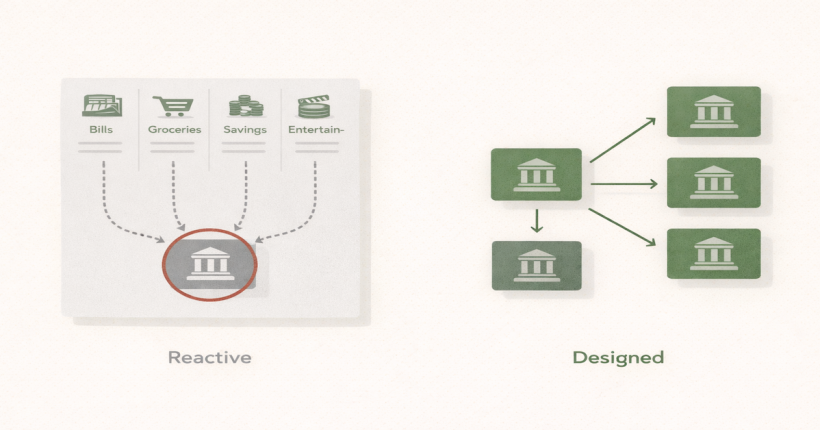
Most people treat their bank accounts as containers — places money sits until it gets spent. But account structure is actually a routing system. The way accounts are organized determines how money moves, what gets protected, and what gets accidentally consumed before it reaches its intended destination.
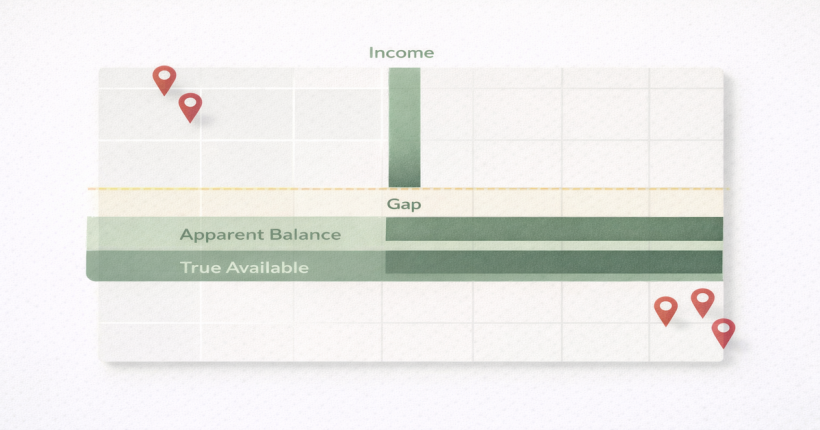
When everything lands in one checking account, the brain sees the full balance as spendable. It does not matter that $800 of that balance is earmarked for rent in two weeks. The account shows $1,400 and spending behavior responds to $1,400. This is why people with sufficient income still overdraft, miss bills, and fail to save — not because they lack discipline, but because the infrastructure makes the wrong behavior easy and the right behavior invisible.
Fix the structure and the behavior follows — without requiring any additional willpower. The Credit, Banking & Cash Flow hub shows how this foundation layer connects to cash flow timing and credit performance across the complete integration system.
The Core Problem: What One Account Does to Finances
The Single-Account Failure Pattern
When income, bills, spending, and savings all share one account, four predictable problems emerge:
Invisible earmarks — money mentally reserved for bills gets spent before the bills arrive. The account shows it as available. It is not.
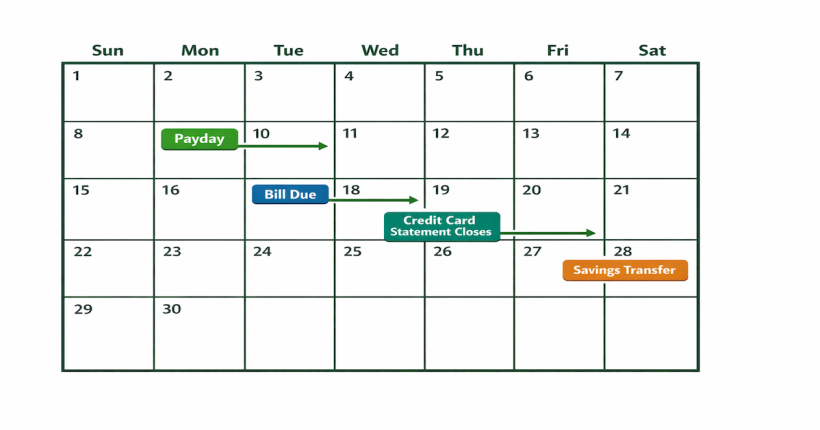
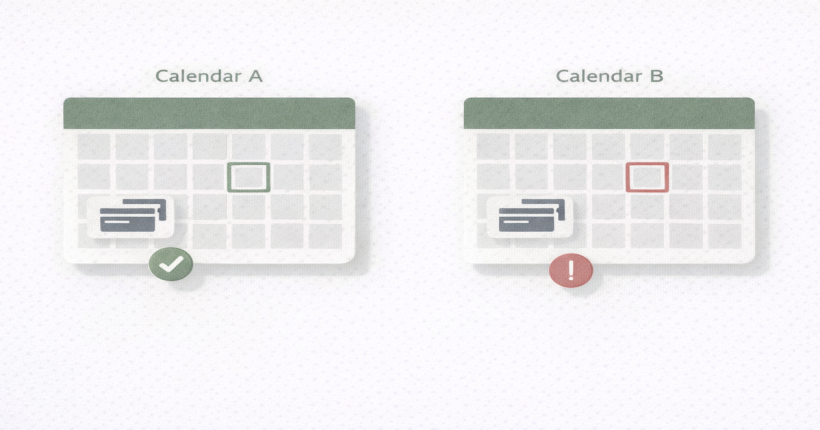
Overdraft risk — bill timing and paycheck timing do not always align. One gap triggers fees and potential credit damage.
Savings erosion — savings in a visible account gets treated as a spending buffer rather than a protected fund. It never accumulates.
Budget collapse — without physical separation, budget categories exist only in a spreadsheet. They have no mechanical enforcement and fail under normal spending pressure.
How Banking Structure Connects to Credit Performance
Account architecture does not just affect cash flow — it directly affects credit. When bills are paid from the wrong account and overdrafts occur, the downstream effects include late payment flags, penalty fees, and credit score damage. When savings bleeds into spending because both share an account, emergency funds do not accumulate, leaving the entire system one unexpected expense away from credit card dependence.
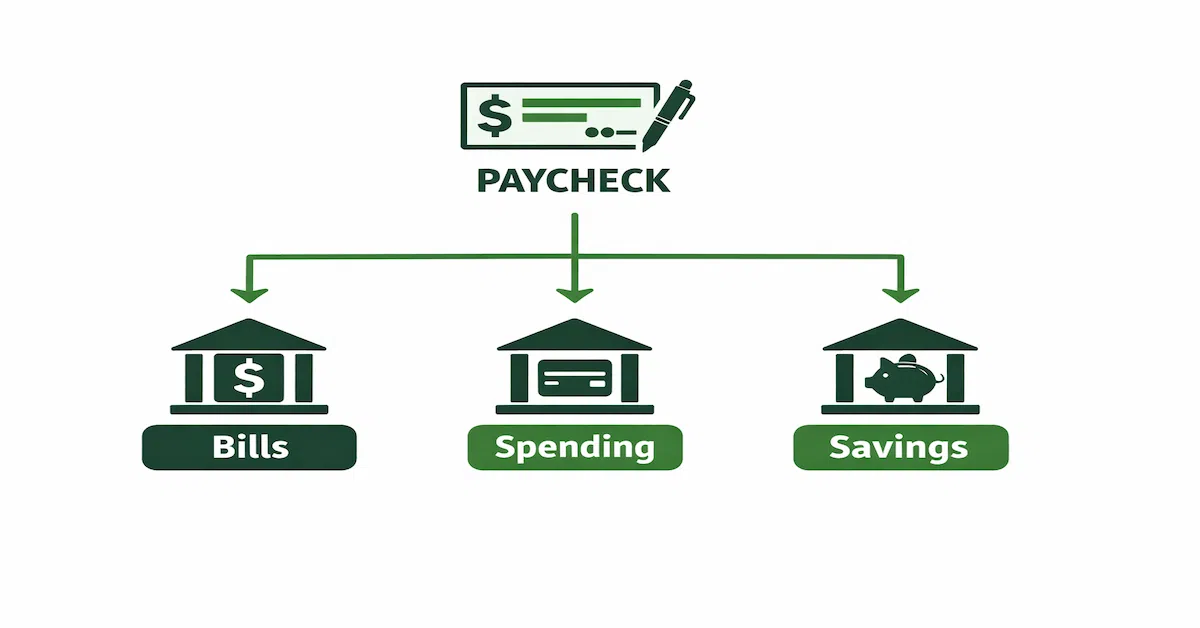
Separating accounts mechanically protects against these failure modes. A Bills Account that receives a fixed transfer on payday and pays obligations automatically never misses a due date. A savings account at a separate institution removes the friction-free access that causes savings to disappear. The infrastructure creates the outcome without requiring active management every month.
Go Deeper: Banking Structure & Cash Flow Control Guides
Each article below focuses on a specific dimension of how banking structure controls cash flow and financial stability. Start with whichever one most closely describes the current problem.
Why Your Bank Accounts Control Your Financial Life
"I have money, but it never seems to be in the right place."
Most people think of bank accounts as passive storage. This article reframes them as an active routing system that determines financial outcomes. Covers how account design shapes spending behavior, why single-account banking creates structural failure regardless of income level, and what the right account architecture looks like as a foundation for the complete PersonalOne system.
The Hidden Cash Flow Problem Most People Have
"My income is fine. Why does money still disappear?"
The most common cash flow problem is invisible — not because income is insufficient, but because money movement is unstructured. Identifies the hidden leaks in single-account systems: timing gaps between income and obligations, spending bleed into protected funds, and the behavioral effects of visible versus separated balances. Introduces structural cash flow design as a replacement for manual tracking.
Why One Checking Account Breaks Your Budget
"I budget every month. It never works."
Budgets fail more often from infrastructure problems than from math problems or willpower failures. Explains the mechanical reason single-account systems undermine even well-designed budgets — and how separating accounts into purpose-specific containers creates structural enforcement that makes budget categories hold without constant monitoring.
The Account Separation Strategy That Prevents Financial Chaos
"I want my money to go where it belongs without me managing it constantly."
The practical implementation guide for multi-account banking architecture. Covers the full separation strategy: which accounts to open, what each one does, how payday routing works, which transfers to automate, and how the structure integrates with bill pay cycles and credit card management. The structural backbone of the PersonalOne cash flow system.
Account Structure Is the Foundation. Everything Else Builds on It.
Get the banking structure right and cash flow, credit, and budgeting all become easier to maintain. The complete three-engine integration model is in the Credit, Banking & Cash Flow hub.
Frequently Asked Questions
How many bank accounts do I actually need?
The minimum viable structure for most people is three accounts: a Bills Account for fixed obligations, a Spending Account for daily variable expenses, and a Savings Account for emergency fund and goals. The Bills Account and Spending Account can be at the same institution for easy internal transfers. The Savings Account works best at a separate online institution where the higher APY and the one to two day transfer delay both serve their purpose — one earns more, one creates friction that protects the balance from casual access.
Why do I keep overdrafting even when my income covers my bills?
Almost always a timing and structure problem, not an income problem. The most common cause is bills and spending money sharing one account — the balance looks sufficient until an autopay fires against money that was already spent. The second most common cause is an underfunded Bills Account that does not account for irregular charges like semi-annual insurance or annual subscriptions. Separating the Bills Account from the Spending Account and calculating the correct transfer amount from a 12-month bills inventory resolves both causes.
Can a better banking structure actually improve my credit score?
Yes — indirectly but reliably. A Bills Account with correct funding ensures every fixed obligation autopays on time, which builds payment history cleanly without missed payments. Removing the overdraft risk eliminates the scenario where a bounced payment triggers a late fee that cascades into a missed minimum. And a Savings Account at a separate institution means emergency funds accumulate instead of being spent, reducing the credit card dependence that drives up utilization. None of these are direct credit interventions — they are upstream infrastructure fixes that produce downstream credit improvements.
What is the difference between this cluster and the Banking Systems hub?
This cluster covers the conceptual and behavioral layer — why account structure matters, how single-account systems fail, and how separation changes financial outcomes. The Banking Systems hub covers the implementation layer — which specific accounts to open, how to evaluate online banks versus traditional banks, how to set up the hybrid banking architecture, and how to execute the complete multi-account setup. Start here for the framework. Go to Banking Systems for the build.
Official Sources
CFPB — Bank Account Consumer Tools and Rights
FDIC — Deposit Insurance Coverage and Verification
CFPB — What Is an Overdraft and How Does It Work?
Connected Hubs
This cluster is the foundation layer of the Credit, Banking & Cash Flow integration hub. Related hubs: Banking Systems — the complete account selection, setup, and multi-account architecture system. Cash Flow Timing & Credit Utilization — once structure is in place, aligning paycheck dates and statement cycles keeps utilization low automatically.
PersonalOne Money System
This content is researched, written, and owned by PersonalOne — a free financial education platform built to help Millennials and Gen Z build real financial systems.
Disclaimer: This content is for educational purposes only and does not constitute financial, investment, or tax advice. Individual financial situations vary significantly. The strategies and systems linked here may not be appropriate for all circumstances. Before making financial decisions, consider consulting with qualified financial professionals. PersonalOne provides educational content and does not provide personalized financial planning services.