May 25, 2026
Home › Financial Stability › Long-Term Resilience › How to Build Financial Resilience
What You Need to Know
— Financial resilience is not about having more money — it is about building a system that absorbs disruption without collapsing
— Resilience is built proactively, before a crisis arrives — the financial habits and structures you put in place today determine how well you survive uncertainty tomorrow
— The five pillars of financial resilience are: cash reserves, income diversification, expense flexibility, debt reduction, and protective coverage
— Resilience is a spectrum — every improvement makes your financial system more durable, even if the full framework is not yet complete
— Economic uncertainty is permanent — building resilience is not a response to a specific threat, it is the baseline condition of a financially stable life
Learning how to build financial resilience is the proactive counterpart to crisis management — and it is what separates people who weather economic disruption with their finances largely intact from those who do not. A financial resilience plan is not built in response to a recession, a job loss, or a market downturn. It is built before any of those things happen, specifically so that when they do, the system absorbs the shock rather than collapsing under it. The complete long-term financial resilience system covers every structural layer of a financially durable life, from cash reserves through income diversification and protective coverage.
The distinction between financial resilience and financial crisis management is timing. Crisis management is reactive — you respond to what has already happened. Resilience is structural — you build the systems that prevent a crisis from becoming a catastrophe before it arrives. Building financial resilience belongs to the proactive planning phase of the financial stability system, not to the emergency response phase. People who build resilience before they need it spend significantly less time in financial crisis than people who try to build it during one.
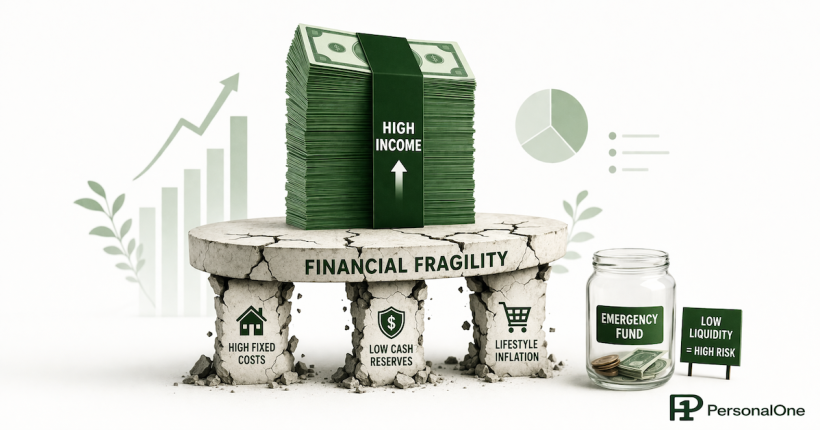
This article covers the five structural pillars of financial resilience, how to assess your current resilience level, and the specific actions that move you from financially fragile to financially durable — regardless of where you are starting from. Understanding why high earners still feel financially fragile is one of the clearest illustrations of why income alone does not create resilience — structure does.
Pillar 1: Cash Reserves — The First Line of Defense
Cash reserves are the foundation of every resilient financial system. Without them, every disruption — an income gap, an unexpected expense, an economic downturn — immediately converts to debt or forced liquidation of investments at potentially unfavorable prices. The minimum cash reserve structure for genuine resilience includes three layers operating simultaneously: a buffer account holding one month of fixed expenses for timing protection, a starter emergency fund of $1,000 for common single-event emergencies, and a full emergency fund of 3–6 months of essential expenses for income disruption. The complete framework for how to build an emergency fund that protects you from setbacks covers all three layers in sequence.
Cash reserves are the element of financial resilience most directly within your control regardless of income. Building them takes time but requires no special knowledge, no investment risk, and no market conditions to cooperate. Every dollar added to your cash reserve layer directly increases your financial resilience in a measurable way.
Pillar 2: Income Diversification — Not Depending on One Source
A single income source is a single point of failure. When that source is disrupted — through job loss, disability, industry downturn, or company failure — your entire income disappears simultaneously. Income diversification reduces this risk by distributing earning across multiple sources so that the loss of any one source creates a gap rather than a complete income collapse. The Side Hustles and Entrepreneurship guide covers the specific frameworks for building secondary income streams alongside a primary career.
Income diversification does not require running a business or working a second job indefinitely. It can be as straightforward as developing a freelance skill that generates occasional project income, building a dividend-paying investment portfolio over time, or developing passive income streams from digital products or content. The goal is to ensure that if your primary income is disrupted, at least some income continues flowing from other sources. A structured financial goal setting framework gives you the method for sequencing income diversification alongside your other resilience priorities without losing focus on any of them.
Pillar 3: Expense Flexibility — The Ability to Cut Without Catastrophe
Expense flexibility is the degree to which your monthly spending can be reduced quickly without threatening survival. A household whose spending is mostly fixed obligations — mortgage, car payments, insurance, minimum debt payments — has low expense flexibility. A disruption requires these payments regardless of income. A household with significant variable and discretionary spending can implement deep cuts quickly, dramatically extending their financial runway during income disruption.
Building expense flexibility means deliberately keeping your fixed obligation ratio below 50% of take-home income, maintaining discretionary spending that can be eliminated without destroying your quality of life, and avoiding lifestyle inflation that converts variable expenses into fixed ones. The framework for how to build a budget that actually works covers the specific budgeting structure that maintains expense flexibility as income grows.
Pillar 4: Debt Reduction — Removing Fixed Obligations
High-interest debt is the most direct threat to financial resilience because it creates fixed monthly obligations that continue regardless of income. A household carrying $15,000 in credit card debt at 22% APR owes approximately $300–$450/month in minimum payments — payments that do not stop during a job loss, a health crisis, or an economic downturn. Eliminating high-interest debt reduces your fixed expense floor, increases your expense flexibility, and removes the compounding interest drain that slows every other financial goal. The Debt Relief guide covers the complete framework for eliminating high-interest debt systematically.
Pillar 5: Protective Coverage — Preventing Catastrophic Loss
Insurance is the pillar of financial resilience most people underinvest in because its value is invisible until needed. A single uncovered medical event, disability, or liability claim can eliminate years of financial progress in a way that no amount of savings or income diversification can fully protect against. Maintaining adequate health, disability, life, and property coverage is not optional for a genuinely resilient financial system — it is the structural protection that keeps every other pillar intact when a catastrophic event occurs. The complete insurance and coverage framework is in the Insurance and Financial Protection guide.
How to Assess Your Current Resilience Level
Rate each pillar on a simple 1–3 scale: 1 = not in place, 2 = partially built, 3 = fully functional. Add your scores. A total of 12–15 indicates a genuinely resilient financial system. A total of 6–9 indicates significant vulnerability in multiple areas. A total below 6 indicates a financially fragile system that would not withstand a moderate disruption without significant damage.
The assessment is not a judgment — it is a prioritization tool. The pillar with the lowest score is your highest-leverage improvement opportunity. Building financial resilience means systematically improving each pillar in sequence, not trying to optimize all five simultaneously. The habits that make this progression sustainable are covered in financial habits in your 20s — the earlier those habits are established, the less correction work resilience-building requires later. Understanding how financial complexity grows with age is equally useful context: each life stage introduces new obligations and exposures that require the resilience framework to expand, not just maintain.
The foundation of long-term financial stability is not a single decision or a single year of good financial behavior — it is the cumulative result of these five pillars operating together. Knowing stability before investing is one of the most important sequencing decisions in the entire framework: cash reserves and debt reduction must precede significant investment activity, or the investment gains are vulnerable to being erased by the first disruption that arrives.
Resilience is built before the crisis — not during it.
The complete Long-Term Resilience framework covers every structural layer of a financially durable life — from cash reserves through income diversification, expense flexibility, and protective coverage.
Explore Long-Term Resilience →Official Sources
Federal Reserve — Report on the Economic Well-Being of U.S. Households — Annual Federal Reserve survey data on household financial resilience, emergency savings capacity, and vulnerability to income disruption across all income levels.
CFPB — Savings Tools and Resources — Consumer Financial Protection Bureau guidance on building the cash reserve layers that form the foundation of financial resilience.
Continue Learning About Financial Stability
This article is part of the Long-Term Resilience cluster. The complete system this cluster belongs to — including every framework for building a stable, durable financial life — is in the Financial Stability guide.
Frequently Asked Questions
How is financial resilience different from financial stability?
Financial stability means your current expenses are covered and you are not adding to debt. Financial resilience means your financial system can absorb disruption — income loss, unexpected expenses, economic downturns — without collapsing. Stability is the baseline. Resilience is the durability layer built on top of it. You need stability before resilience is meaningfully achievable.
Can I build financial resilience on a low income?
Yes — every pillar of resilience is buildable at any income level, though the timeline is longer at lower incomes. Cash reserves scale to your expense level, not your income level. Expense flexibility is often higher at lower income levels because fixed obligations are smaller. Income diversification at lower incomes often starts with a single side skill rather than a portfolio of income streams. The principles apply universally; the pace varies.
What is the first pillar I should focus on?
Cash reserves. They provide the most immediate protection against the most common disruptions and require no special skills or market conditions. Build the starter emergency fund first, then the buffer account, then the full emergency fund. Once the cash layer is in place, the other pillars become significantly easier to build because you are not constantly diverting resources to financial emergencies.
Disclaimer: This article is for informational and educational purposes only and does not constitute financial advice. Individual financial situations vary — consult a qualified financial professional for personalized guidance.