July 2026
Home › Financial Stability › Long-Term Resilience › Why High Earners Still Feel Financially Fragile
What You Need to Know
— A high income can make a household look stable without making it resilient
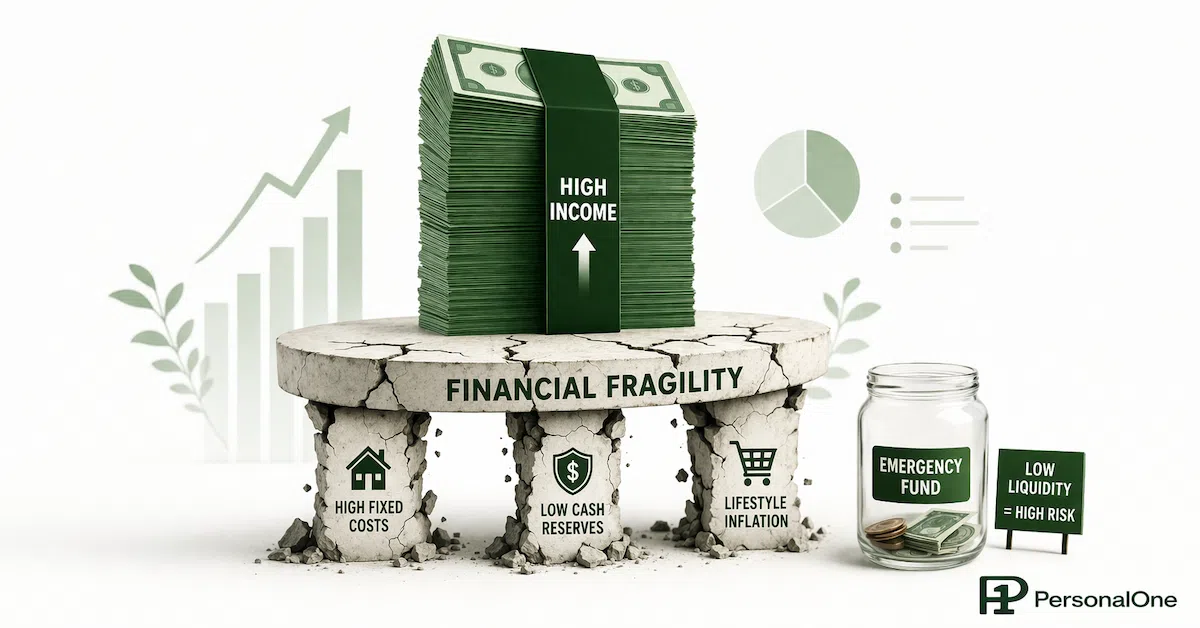
— Many high earners still feel financially fragile because fixed costs, lifestyle inflation, and weak cash reserves erase the margin that income should have created
— Financial resilience is not about how impressive your paycheck looks — it is about whether your system can absorb disruption without breaking
— High earners often have asset growth on paper but weak liquidity in real life, which creates stress even when income is strong
— The solution is usually not more income first — it is stronger cash flow structure, lower fixed pressure, and better protection layers
One of the strangest money experiences is earning more than you ever thought you would and still feeling nervous every time a bill hits, a bonus gets delayed, or something expensive breaks. On paper, that situation looks like success. In real life, it can feel like financial instability wearing better clothes.
This article sits inside the long-term financial resilience system because resilience is what separates a high-income life from a stable one. Inside PersonalOne's financial stability system, the question is never just how much money comes in. The bigger question is whether the system underneath that income can carry real life without constant strain.
That difference matters more than people think. A household can have a strong salary and still be exposed to fragile cash flow, rising fixed costs, low liquid savings, and lifestyle obligations that are expensive to maintain. That is why some high earners still feel like one bad month could send everything sideways.
Why a Bigger Paycheck Does Not Always Create Stability
A raise solves one problem. It does not automatically solve five others. Income can increase while housing costs rise, subscriptions multiply, convenience spending expands, debt payments stay high, and savings remain inconsistent. When that happens, higher earnings improve appearance more than structure.
That is the trap. A bigger paycheck creates the feeling that there should be more breathing room, but if every dollar is quickly claimed by fixed expenses or higher lifestyle expectations, the margin never really appears. The person is earning more, but the system is still fragile.
This is also why some people feel guilty about their stress. They assume that because their income looks solid, they no longer have the right to feel pressure. But fragility is not measured by status. It is measured by how easily your setup gets shaken.
What Financial Fragility Actually Looks Like
Financial fragility does not always look like overdrafts or collections. Sometimes it looks far more polished than that. It can show up as:
High income with low liquidity. Retirement balances may be growing, home equity may be building, and income may be respectable, but cash reserves are thin. The household looks healthy until something urgent needs to be paid in cash.
Dependence on the next paycheck. Bills are covered, but only if income keeps arriving exactly on time. If one disruption lands at the wrong moment, the whole month starts wobbling.
A life that became expensive to maintain. Upgrades often become obligations. Better housing, better car payments, higher childcare, more recurring services, more convenience spending, and a higher social "normal" all create pressure that does not disappear just because income is higher.
No real shock absorber. If a job changes, a bonus misses, a repair bill lands, or family obligations increase, there is no real buffer sitting between the event and the household's peace of mind.
The Real Causes of High-Earner Fragility
1. Fixed costs scaled up too fast. A lot of people do not suddenly become reckless when they earn more. They just slowly raise their baseline. The nicer apartment, the upgraded car, the more expensive routines, the extra services, and the "we can afford it now" decisions all start to stack. Over time, a bigger income becomes a bigger maintenance requirement. Understanding how to structure your budget and cash flow is how you prevent fixed costs from quietly swallowing the margin that a higher income should have created.
2. Emergency savings never became a protected system. Many higher earners save in theory but not in infrastructure. They save when there is "extra," which means savings remains optional. That works until life stops being cooperative. Readers who need to strengthen that layer should read how to build an emergency fund that protects your income and Buffer Account System.
3. Cash flow is stronger annually than monthly. This is common for commissions, bonuses, self-employment, contract work, and uneven pay cycles. Annual income may look great while monthly reality still feels choppy. That is a cash flow design problem, not just an income problem. That is why this article naturally connects to Income Volatility Management and Where Your Paycheck Should Go First.
4. Lifestyle inflation outran resilience. The lifestyle is not necessarily outrageous. It is just expensive enough that backing down from it would hurt. That is what makes it fragile. Not because it is flashy, but because it has no flexibility.
5. The structure underneath the income never got upgraded. A person can earn far more than they used to while still running their finances through one checking account, inconsistent savings habits, reactive bill timing, and no layered reserves. That setup might work during good months, but it stays vulnerable.
Internet Red Flags Around High Income and Stability
Social media makes this topic worse because it turns nuanced financial realities into lazy one-liners. You will hear things like "If you make six figures, you should be fine" or "Budgeting is only for broke people." Both ideas sound confident. Neither is especially useful.
Income matters, but structure decides whether that income actually creates safety. A household earning less but living with margin, savings, and cleaner cash flow can feel much more secure than a household earning more while carrying high fixed overhead and weak liquidity.
That is why PersonalOne treats financial resilience like infrastructure. The goal is not to shame high earners for feeling pressure. The goal is to explain why the pressure exists and show what actually removes it.
What High Earners Usually Need More Than Another Raise
A better account structure. If all money still flows through one general account, it is harder to create clarity and harder to protect important categories. The next step is often a better system, not more hustle. Related reads here include The 3-Account System Explained and Multiple-Account Budgeting System.
A lower-pressure version of normal life. Resilience gets stronger when the household's baseline becomes easier to carry. That may mean trimming fixed commitments, reducing convenience dependence, or making sure upgrades do not turn into permanent burdens. Learning how to build financial resilience into your day-to-day structure is how you make sure lifestyle changes actually stick instead of quietly reversing under pressure.
A real buffer between income and obligations. High earners often focus on optimization first — investing, maximizing returns, building net worth. Those are good goals. But getting stability before investing is the sequencing decision that most high earners skip, and it is exactly why the system still feels shaky even when income is strong.
A long-term resilience mindset. What feels stable in one life season may feel thin in the next. Marriage, kids, caregiving, relocation, self-employment, or income shifts all change what a resilient system requires. Stability has to be maintained, not assumed.
A strong income is helpful. A strong system is safer.
This article is one part of the Long-Term Resilience cluster. The full system for building durable financial strength lives in the cluster hub.
Long-Term Resilience →The Better Definition of Financial Strength
Financial strength is not "I make a lot of money." It is "my system can absorb disruption without unraveling." That is a very different standard, and honestly, it is the one that matters.
Once you start measuring your finances that way, the next steps become clearer. You focus less on looking stable and more on becoming hard to destabilize. That shift pushes attention toward liquidity, buffers, account separation, lower fixed pressure, and more intentional cash flow.
That is the deeper point of this article. High earners who still feel fragile are not necessarily failing. Many are simply running a bigger life on a system that was never redesigned for resilience.
Resources
Official Sources
Federal Reserve: Economic Well-Being of U.S. Households in 2024 — data on emergency savings, ability to cover disruptions, and financial condition.
CFPB: An Essential Guide to Building an Emergency Fund — explains why emergency savings matter for financial stability.
CFPB: Financial Well-Being in America — broader framework for understanding financial security beyond income alone.
Continue Learning
This article is one part of the complete Long-Term Resilience cluster inside the Financial Stability authority hub.
7 Smart Financial Moves for Every 20-Something — a practical guide to building strong financial habits early before complexity and obligations start stacking up.
How Financial Complexity Grows With Age — explains why money systems need to get stronger as life stages, responsibilities, and financial moving parts increase over time.
Frequently Asked Questions
Can someone earn a lot and still be financially unstable?
Yes. High income can reduce financial pressure, but it does not automatically create resilience. A household can still be fragile if savings are weak, fixed costs are high, and cash flow depends on the next paycheck landing on time.
Why do high earners still feel paycheck to paycheck?
Often because their lifestyle expanded with income, leaving little margin. Higher housing, car costs, debt payments, recurring services, and thin cash reserves can make a strong salary feel much smaller in practice.
What is the difference between wealth and resilience?
Wealth usually refers to assets and net worth over time. Resilience refers to how well your system handles disruption in real life. A person can have growing assets and still have weak day-to-day financial stability.
What should a high earner fix first?
Usually the first fixes are structural: emergency savings, better cash flow design, account separation, and lower fixed-cost pressure. Those changes often reduce stress faster than simply trying to increase income again.
Does this topic belong under Financial Stability even if the reader is earning well?
Absolutely. Financial Stability is about the strength of the system, not just the size of income. High earners often need stability work just as much as lower earners — it just shows up differently.
Disclaimer: This article is for informational and educational purposes only and does not constitute financial or legal advice. Individual financial situations vary. Consult a qualified financial advisor before making significant financial decisions. PersonalOne is not a licensed financial advisor.