June, 2026
Home › Banking Systems › Account Separation for Different Life Stages › The Right Bank Account Setup for Your First Real Job
Part of the Account Separation for Different Life Stages cluster — inside the Banking Systems hub.
What You Need to Know
— Your first real paycheck is a system design moment — the structure you set up now determines where your money goes for the next several years.
— One checking account handles everything is the most common first-job mistake — it makes overspending invisible and saving accidental.
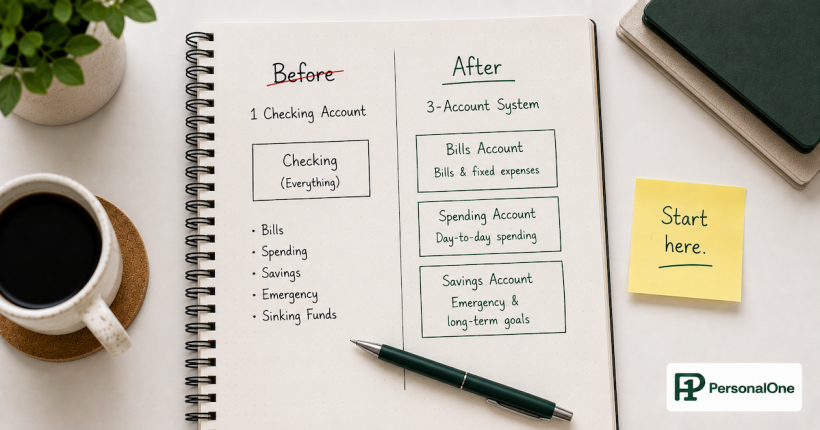
— The correct first-job setup is three accounts: a no-fee checking account, a no-fee bills account, and a high-yield savings account.
— Automating transfers on payday is what makes the system work — savings happen before spending, not from whatever is left.
— This setup takes about 45 minutes to build and runs with almost no maintenance after that.
Your first real paycheck just landed. Not a part-time shift, not a summer internship stipend — a real salary, direct deposited, every two weeks. It probably feels like a lot of money. And it probably will not feel that way for long if you do not set up the right structure for it immediately.
Most people in their first real job treat their checking account like a single pool that everything flows in and out of. Income arrives, rent leaves, food and subscriptions drain it gradually, and by day twelve of a two-week pay cycle there is not much left. Nothing went wrong specifically. There was no emergency. The money just disappeared into undifferentiated spending because there was no architecture telling it where to go.
The bank account setup your first real job requires is not complicated. It is three accounts with defined roles, funded automatically on payday, running on their own after the initial setup. This is the same structure that sits at the core of a proper bank account structure for each life stage — the first job version is the foundation everything else gets built on top of.
If you want the full architecture — how all accounts connect across income types and financial goals — the banking system for money management hub covers the complete framework. This article focuses on the specific setup that works for someone with their first real steady income.
Why Your First Paycheck Is a System Design Moment
The financial habits you build in your first real job are remarkably sticky. Research on financial behavior consistently shows that savings rates, account structures, and spending patterns established in early career tend to persist — sometimes for decades — because they become the baseline against which everything else is measured. Your first real paycheck is not just income. It is the first input to a financial system you are designing, consciously or not.
Designing it consciously takes about 45 minutes. Designing it by default — opening one checking account and seeing what happens — takes zero minutes and costs significantly more over the following years in fees, impulsive spending, underfunded emergencies, and delayed financial goals.
The Most Common First-Job Banking Mistake
Using a single checking account for everything — income, bills, spending, and savings — makes financial progress invisible. You cannot see how much is protected for bills versus available to spend. You cannot tell if you are saving or just not spending. The account balance tells you nothing useful except the total, which is always lower than you expect and higher than what is actually safe to spend.
The Three-Account Setup for Your First Real Job
The correct first-job banking structure is not complex. Three accounts, each with one job, each funded automatically. Here is what each one does and why it needs to exist separately.
Account 1 — Spending Checking Account
Purpose: Variable daily expenses — groceries, gas, dining, subscriptions, personal spending
This is the account your debit card is attached to. It holds exactly your budgeted discretionary spending for the pay period — nothing more. When the balance reaches zero before your next paycheck, spending stops. The balance is the answer to every spending question.
What to look for: No monthly fees, no minimum balance, large ATM network or unlimited reimbursements, no overdraft fees. Ally, Capital One 360, Axos, and Discover all qualify. For the full comparison of no-fee checking options, the best no-fee banks guide covers all current options.
Key setup step: Do not attach your bills account or savings account debit card to online shopping. Spending account only. This creates the physical separation that makes the system work.
Account 2 — Bills Checking Account
Purpose: Fixed monthly obligations — rent, utilities, insurance, subscriptions, minimum loan payments
This account exists to protect bill money from spending. Every fixed obligation autopays from this account. You never touch it for discretionary purchases. The balance builds before the billing cycle, draws down as bills hit, and rebuilds after the next payday transfer. You never have to think about it.
How to fund it: Calculate your total fixed monthly obligations. On payday, transfer exactly that amount here automatically. Nothing extra. Bills account holds bill money and nothing else.
Why it matters: When bills and spending share one account, every purchase is a quiet gamble that bill money will still be there when obligations hit. Separation eliminates that gamble permanently.
Account 3 — High-Yield Savings Account
Purpose: Emergency fund, short-term goals, anything not being spent this month
This account lives at a separate online institution from your checking accounts. The 1–3 day transfer window is a feature, not a limitation — it creates enough friction to prevent impulsive withdrawals while keeping genuine emergency access realistic. Top HYSAs currently pay 4.00–5.00% APY versus the national average of 0.38% at traditional banks.
First goal: Build a $1,000 starter emergency fund before anything else. Then grow to one month of essential expenses. Then three to six months. Each milestone materially changes your financial risk profile. For the complete step-by-step process of opening an HYSA and setting up automated transfers, the high yield savings account setup guide covers every step in under 10 minutes.
Rate reality: $5,000 at 0.38% APY earns $19/year. The same $5,000 at 4.50% APY earns $225/year. That $206 difference is the cost of keeping your savings at a traditional bank.
How to Fund All Three Accounts on Payday
The funding sequence is what makes the three-account system work. Money moves in a specific order on payday before you touch any of it. The sequence is not negotiable — it is the mechanism that forces saving to happen before spending rather than from whatever is left.
The Payday Funding Sequence
Step 1 — Paycheck arrives in spending checking (or split via payroll if your employer allows it)
Step 2 — Automatic transfer to bills account fires same day — exact amount of fixed obligations for the period. Bills are funded before you see the money.
Step 3 — Automatic transfer to HYSA fires same day — your predetermined savings amount moves before discretionary spending has access to it.
Step 4 — What remains in spending checking is your discretionary budget for the pay period. Spend it freely — everything important is already protected.
Most employers allow direct deposit splits — sending a fixed dollar amount to one account and the remainder to another. If yours does, send your bills amount directly to your bills account and your savings amount directly to your HYSA. Zero manual transfers needed. If not, set up automatic transfers from your spending checking on payday and they fire within minutes of your deposit clearing.
What to Do With Your First Few Paychecks
Before the system is fully running, the first few paychecks have a specific priority order. Trying to do everything simultaneously before the foundation is built leads to underfunded accounts and system failures.
First 90 Days Priority Order
Paycheck 1–2: Open all three accounts. Set up direct deposit. Set up automatic transfers. Get the structure in place before optimizing anything.
Paycheck 3–6: Build $1,000 starter emergency fund in HYSA. This is your first financial buffer — the difference between a car repair being a problem and a catastrophe.
Paycheck 7–12: If your employer offers a 401(k) match, enroll and contribute at least enough to capture the full match. This is free money — not capturing it is leaving part of your compensation unclaimed.
Month 4 onward: Grow emergency fund to one month of essential expenses. Then increase savings rate incrementally as the system stabilizes and income grows.
The Numbers: What a First-Job Setup Actually Looks Like
Here is how the three-account structure translates to real dollar allocations for two common first-job income levels:
| Category | $45K Salary ($1,730 biweekly take-home) | $65K Salary ($2,500 biweekly take-home) |
|---|---|---|
| Bills account (rent + fixed) | $900 | $1,200 |
| HYSA transfer (savings) | $200 (11.5%) | $375 (15%) |
| Spending checking (discretionary) | $630 | $925 |
| Emergency fund at 6 months | ~$5,400 | ~$7,200 |
These are starting points, not rules. Adjust the bills allocation to your actual fixed obligations and the savings rate to what is realistic in your first few months. The structure matters more than the percentages. Once it is running, you can optimize the numbers as your income and obligations clarify. As your income grows beyond your first job, the upgrade your bank as your income grows guide covers exactly when and how to evolve the structure.
Three Things That Derail First-Job Banking Setups
Keeping your student bank account
Student checking accounts are designed to convert to fee-charging accounts upon graduation. Many do this automatically without notification. The monthly maintenance fee that kicked in when your student status ended may already be draining your account. Verify your current account type and switch to a genuinely fee-free account immediately if you are being charged.
Saving manually instead of automatically
Manual saving — deciding each pay period how much to move — fails because discretionary spending expands to fill available balance. When the HYSA transfer is automatic and fires on payday before you see the money, savings happen consistently regardless of whether you remember or feel disciplined enough. Automation removes the decision entirely.
Lifestyle inflation without system adjustment
The first real paycheck often triggers immediate lifestyle upgrades — better apartment, new car, dining out more frequently. Each upgrade locks in a higher fixed obligation that reduces future financial flexibility. The structure prevents this by making bills visible and separate. If a new fixed cost is added to the bills account, the reduction in discretionary spending is immediately apparent rather than hidden in one blended balance.
First Job. First Real System. Build It Once.
The account structure you set up now is the foundation every financial decision gets made on top of for the next several years. The 3-Account System shows you exactly how checking, bills, and savings connect so your income works on autopilot from day one. For the complete framework covering every life stage, see the Banking Systems hub.
Infrastructure first. Discipline optional.
Official Sources
FDIC — Your First Job: Banking and Financial Basics
Continue Building Your System
This article is part of the Account Separation for Different Life Stages cluster. The cluster covers how the right account structure changes at each major income and life stage — from first job through growing income, homeownership, and beyond.
Frequently Asked Questions
Do I need to open all three accounts before my first paycheck?
Ideally yes — at minimum have your spending checking and HYSA open and linked before payday one. The bills account can be added in the first two weeks. If you can only do one thing before your first paycheck arrives, open the HYSA and set up an automatic transfer. Savings automation is the highest-leverage single action you can take.
Should my bills account and spending checking be at the same bank?
Yes — keeping both checking accounts at the same institution makes transfers between them instant and fee-free. Your HYSA should be at a separate online institution for the rate advantage and the transfer friction that protects savings from impulse spending.
What if I still have a student loan or credit card debt from college?
Include minimum debt payments as fixed obligations in your bills account. The emergency fund ($1,000 starter) still comes first — without it, any financial disruption sends debt higher. Once the starter fund is in place, evaluate whether aggressive debt paydown or continued savings is the right balance for your specific interest rates and situation.
How much should I actually be saving on my first real salary?
Start with whatever is realistic — even $50 per paycheck automated is a foundation. A reasonable first-year target is 10% of take-home. The percentage matters less than the automation. Once saving is automatic and consistent, increasing the rate becomes a settings adjustment rather than a discipline challenge.
When should I upgrade or change this setup?
The three-account structure works across income levels and life stages — you are adjusting allocations and institutions, not the architecture itself. The main trigger for structural change is a significant income increase, major new fixed obligation (lease, mortgage), or addition of investment accounts. The upgrade your bank as your income grows guide covers exactly what to change and when.
This content is for educational purposes only and does not constitute financial advice. PersonalOne is not a licensed financial advisor, broker, or investment professional. Individual financial situations vary. Account features, APYs, and fee structures are subject to change — always verify current terms directly with financial institutions before opening accounts.