June 7, 2026
Home › Financial Stability › Income Volatility Management › How to Build Stability on a Minimum Wage Income
What You Need to Know
— Building stability on minimum wage is harder than building it on higher income — but the sequence is the same and the structure is achievable
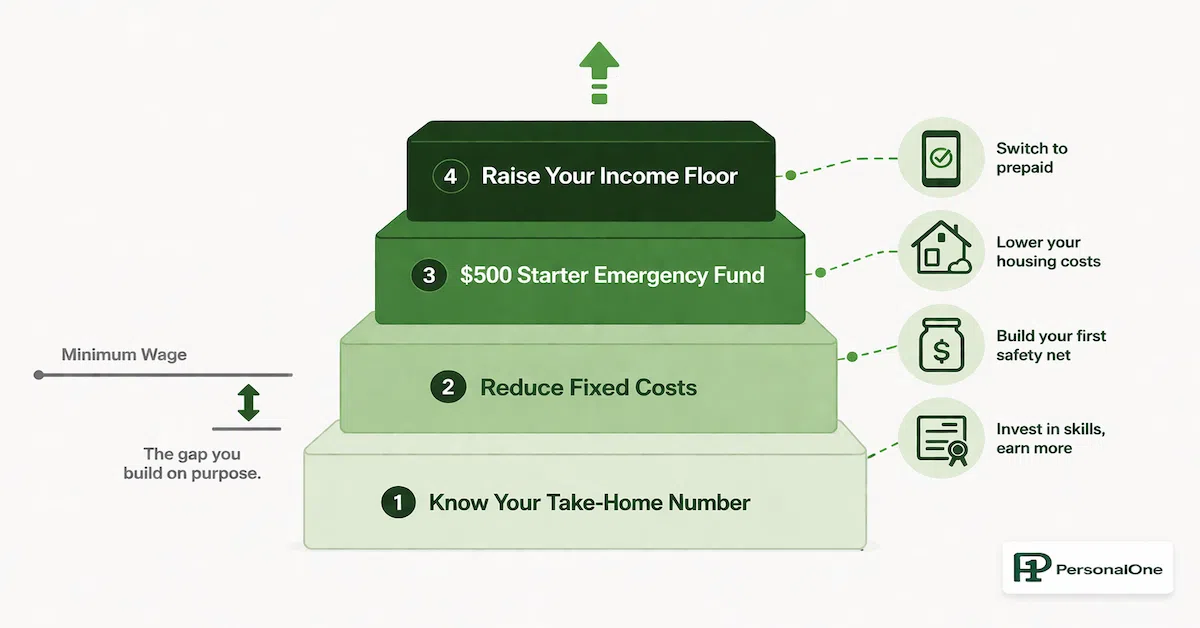
— Know your exact take-home number, not your hourly rate — the real number is what hits your account after every deduction
— Reduce fixed costs aggressively before trying to save — margin only appears when expenses are compressed below income
— A $500 starter emergency fund is the realistic first savings goal — it breaks the cycle where any unexpected expense creates a debt spiral
— Raising income must be treated with the same urgency as cutting expenses — stability on minimum wage is a starting point, not a permanent destination
Managing irregular income with a low overall income level adds a layer of difficulty that most financial frameworks fail to address directly. Standard advice — save 20%, build a 6-month emergency fund, invest early — assumes meaningful margin between income and expenses. At or near minimum wage, that margin is often nonexistent or negative.
This is not a motivation problem. It is a math problem. And math problems require math solutions — not harder work or more discipline, but a different approach to the variables you can actually control. Managing irregular income at a low income level requires a specific sequence of priorities, a clear-eyed view of what is possible now, and an active plan to improve the income itself over time.
The framework below is part of the broader income volatility planning system but adapted specifically for situations where total income is a binding constraint, not just an unpredictable one. If your income is irregular but not yet structured around any system, the irregular income survival guide provides the foundational context this framework builds on.
Why Stability Is Harder on Minimum Wage — And Why It Still Matters
The challenge of building stability on minimum wage is not perception — it is arithmetic. A full-time worker at the federal minimum wage earns approximately $15,080 annually before taxes. After federal, state, and payroll taxes, take-home pay in most states falls between $11,500 and $13,000 per year, or roughly $960 to $1,080 per month. In most U.S. metro areas, that take-home covers little beyond housing and food.
At this income level, any unexpected expense — a $400 car repair, a medical bill, a broken phone — creates a genuine financial crisis with no obvious recovery path. Research from the Federal Reserve has consistently shown that a significant share of American adults cannot cover a $400 emergency expense without borrowing or selling something. For minimum wage workers, that vulnerability is structural, not behavioral.
Why pursue stability in this context at all? Because the absence of even a minimal financial buffer makes every other life decision harder. Instability forces higher-cost short-term decisions — payday loans, late fees, overdraft charges, skipped maintenance — that compound over time and make future financial progress exponentially harder. Building any level of stability, even a small buffer, breaks this cycle and creates the first platform for upward mobility. The financial stability hub covers the full progression from this foundational phase through long-term resilience.
Start with the Exact Take-Home Number
Every financial plan begins with the real number — not the hourly rate, not gross pay, not the amount from an online calculator. The number that matters is the specific deposit that hits your account after every deduction: federal income tax, Social Security, Medicare, state income tax, and any employer benefit deductions.
For minimum wage workers with variable hours — which is common in retail, food service, and hospitality — the take-home varies week to week based on hours scheduled. To plan around this, calculate your minimum weekly take-home using your fewest-hours week in the last 3 months. Then calculate your average weekly take-home. The minimum becomes your budget floor. The average tells you how much surplus is realistic to plan for in a typical week.
If your hours are genuinely erratic — some weeks 15 hours, others 35 — your income is volatile at both the rate and the hours level simultaneously. This is one of the most difficult income structures to plan around. The step-by-step structure for how to plan your budget around a variable paycheck covers exactly this scenario — including how to set a floor, define a variable tier, and handle the overflow when better weeks arrive.
Reduce Fixed Costs Before Trying to Save
On a minimum wage income, savings only become possible when fixed expenses are compressed to the point where they leave meaningful margin. This compression step is not optional — it is the foundational work that makes everything else possible.
Housing is the largest fixed expense for most people and the most impactful lever. If current housing costs exceed 35 percent of take-home pay, this is the most high-priority problem in the financial system. Options for reduction include taking on a roommate, relocating to a lower-cost area, moving back with family temporarily, or accessing income-based housing programs if eligible. These decisions involve real trade-offs, but the math does not work without resolving housing cost if it is consuming more than a third of take-home.
Beyond housing, audit every fixed monthly cost. Phone carriers — prepaid options often cost 60 to 70 percent less than major carrier contracts for the same basic service. Subscriptions — cancel any that are not essential to employment or basic function. Insurance — review whether current coverage levels are appropriate for your situation. Debt minimums — if consumer debt minimums are consuming significant income, prioritize eliminating smaller balances to remove those payments entirely. Even $50 per month freed from a minimum payment meaningfully improves margin at this income level. A structured approach to how to build a budget that actually works gives you the framework for tracking these fixed costs and finding where compression is possible.
Build the $500 Starter Emergency Fund First
A full 3 to 6 month emergency fund is the right long-term target. On minimum wage, that target can feel so distant that it never gets started. The alternative is a staged approach: build a $500 starter fund as the immediate goal, then $1,000, then 1 month of expenses, then build toward a full fund incrementally.
Five hundred dollars covers the most common emergency expenses — a car repair, an ER copay, a short-notice bill — that would otherwise require debt. It does not cover everything, but it interrupts the cycle where any unexpected cost creates a debt spiral. A $500 fund is not the finish line; it is the first stable foothold.
To fund it on a minimum wage budget: if you receive a federal tax refund, commit a defined portion or all of it to the starter fund before it is spent. If fixed cost reduction created $30 to $60 per month of margin, direct that margin automatically to a separate savings account immediately. One-time income events — birthday money, bonus hours, a sold item — can jumpstart the fund faster than incremental saving. Keep the starter fund in a separate account from your checking, even at a different bank. The full framework for how to build an emergency fund starting from zero covers account structure, target amounts, and how to size the fund as income grows.
Raise Income as Urgently as You Reduce Expenses
Expense compression on minimum wage buys breathing room. It does not build wealth. The income side of the equation must be addressed with the same urgency as the expense side — not as a vague future goal, but as an active current priority.
Advancement within your current employer. Most hourly employers have a pay scale with advancement tiers. Moving from entry-level to a lead or specialist role often represents a $2 to $4 per hour increase at the same employer. This is the lowest-effort, fastest path to a higher floor. Ask specifically what skills or milestones are required for the next pay tier and pursue them directly.
Skill-based lateral move to a higher-paying field. Many skilled trade certifications, healthcare support roles, and technical entry-level positions require 3 to 18 months of training and pay significantly above minimum wage. Community colleges, employer-sponsored training, and low-cost or free online certification programs make this accessible. The income increase from one certification can permanently change your financial floor.
Secondary income source. A part-time secondary income — even $200 to $400 per month — can meaningfully change the math on a minimum wage primary income. The key discipline: that secondary income goes entirely to the starter fund and then to the full emergency fund before any lifestyle expansion. Knowing how to earn more with a side hustle as a stability tool changes the frame — the secondary income is floor-building money, not spending money, until the emergency fund is fully funded.
A Simple Three-Account Structure for a Tight Budget
A full multi-account banking architecture may feel like a system designed for higher earners. It is not. The structure scales down and is arguably more important at a minimum wage income level, because every dollar needs a specific place to go and treating all money in checking as available to spend is the most damaging habit in tight-budget management.
The simplified version: a primary checking account where your paycheck deposits and variable day-to-day expenses are covered. A second account — checking or savings — where you pre-fund monthly fixed expenses and bills auto-pay from it; this account is never touched for anything else. A separate savings account, ideally at a different institution, where your starter fund sits and grows for true emergencies only. Three accounts, zero monthly fees if you use credit unions or no-fee online banks, and clear structural separation between money that is spoken for and money that is available. A solid multi-account banking system creates the clarity that prevents the most damaging budgeting habit at any income level.
Build the system behind the stability
This article addresses income volatility at the minimum wage level. The cluster hub connects this to the full Income Volatility Management framework — including buffer architecture, allocation protocols, and the complete stability system.
Income Volatility Management →What Financial Stability Actually Looks Like at This Income Level
Financial stability at minimum wage does not look like wealth. It looks like: a $500 to $1,000 emergency fund that prevents a single unexpected expense from derailing everything, fixed expenses consistently covered, no new high-interest debt being added, and an active plan to raise income over the next 12 months.
That is a realistic 6 to 12 month target. It is not the finish line — but it is the first stable platform from which every subsequent financial move gets easier. Stability at minimum wage is not the destination. It is the foundation that makes the next step possible.
Official Sources
DOL: Minimum Wage Information — Department of Labor guidance on federal and state minimum wage standards and worker rights.
CFPB: Saving and Building an Emergency Fund — Consumer Financial Protection Bureau tools and guidance on building savings at any income level.
BLS: Occupational Outlook Handbook — Bureau of Labor Statistics career and wage data for evaluating higher-paying roles and advancement opportunities.
IRS: Earned Income Tax Credit (EITC) — Official IRS guidance on eligibility and claiming the Earned Income Tax Credit, which can provide a significant refund for low-income workers.
SBA: Starting a Side Business — Small Business Administration guidance on registering and operating a small business or side income source.
Continue Learning About Financial Stability
This article is one part of the complete income volatility framework. The full system — including buffer architecture, account structure, and allocation protocols — is in the Financial Stability guide.
Frequently Asked Questions
Is it even possible to save money on minimum wage?
In many high-cost-of-living areas, saving on minimum wage requires structural changes first — reducing fixed costs, sharing housing, or accessing benefit programs — before any margin appears for savings. The honest answer is that minimum wage income often does not produce meaningful savings without also addressing fixed expenses, income growth, or both. The $500 starter fund goal is achievable in most situations given time, even if it takes a full year of small, consistent contributions.
Should I pay off debt or build savings first on minimum wage?
Build the $500 starter emergency fund first, even if you carry high-interest debt. This is counterintuitive — high-interest debt costs real money — but the absence of any buffer means the next unexpected expense goes directly onto debt, which undoes any payoff progress. Get to $500 in savings first, then redirect margin to eliminating the highest-interest debt. Once high-interest debt is cleared, the freed minimum payment creates more margin to build the full emergency fund.
Are there assistance programs that can help?
Yes. The Earned Income Tax Credit can provide a meaningful annual tax refund for low-income workers — in some cases several thousand dollars — that can fund or significantly boost a starter emergency fund in a single event. SNAP, Medicaid, CHIP, and utility assistance programs such as LIHEAP reduce fixed cost burdens for those who qualify. These programs exist specifically to create the margin that minimum wage alone often does not. Accessing them is a practical financial decision.
How do I handle variable hours on minimum wage when planning a budget?
Budget to your minimum-hours week, not your average. If you work anywhere from 20 to 38 hours per week, calculate your take-home on 20 hours and build your fixed expense baseline to that number. Every week where hours exceed your minimum, the additional take-home goes first to the buffer and then to the emergency fund. This means your budget never assumes hours that were not actually scheduled.
When should I start thinking about investing on a minimum wage income?
Investing should wait until three foundational elements are in place: a fully funded starter emergency fund at minimum $500, no high-interest consumer debt, and a stable fixed expense structure that fits within your reliable minimum income. If your employer offers a 401(k) match, contribute enough to get the full match first — that match is an immediate 50 to 100 percent return before any market movement. Beyond employer match, focus on the stability foundation before diverting cash to investment accounts.
Disclaimer: This article is for informational and educational purposes only and does not constitute financial, tax, or legal advice. Tax treatment of compensation components changes and varies by individual circumstances — consult a qualified tax professional for guidance specific to your situation. PersonalOne is not a licensed financial advisor.